



What is an SR-22?
An SR-22 is a certificate of financial responsibility that is mandated by some states or courts for certain drivers. It is not an actual type of auto insurance but rather a form filed with the state as proof that an individual has auto insurance with the minimum liability coverage required by law. An SR-22 is also referred to as a Certificate of Financial Responsibility, or an FR-44 in Virginia and Florida. It is a common misconception that SR-22 automobile insurance is a type of vehicle insurance, when in actuality SR-22 is simply a document provided by an insurance company that proves the driver has liability coverage.
Before an insurance company provides an SR-22 certificate, the individual must have car insurance. By providing an SR-22, the insurance company is guaranteeing to the state’s Department of Motor Vehicles that the driver has a valid auto insurance policy and is financially responsible for any damages caused in an accident. Some insurers may deny coverage or will not provide SR-22 forms due to the risk associated with these drivers.
It is important to note that SR-22 insurance is not a type of insurance, but rather a form filled out by an insurance company to guarantee that the driver has continuous insurance that meets the state’s minimum coverage requirements. SR-22 forms are also known as high-risk insurance or DUI insurance and are required after serious traffic offenses in California. Filling out an SR-22 is a way for an insurer to demonstrate to the state that the driver is abiding by the law and carrying adequate insurance.

YoGi Prime Trunk and Backseat Car Organizer
- Premium Heavy-duty Design: Reinforced side walls and non-slip bottom to keep the box organizers in place.
- Privacy Cover: Increases storage capacity and prevents small items or grocery bags from spilling out.
- Heavy-duty Materials: Designed to last for years.
- Lifetime Warranty: Risk-free purchase with a money-back guarantee. No games, no fuss, no runarounds.
- Quantity Discounts: Save 5% on a purchase of 2 and 10% on 3 or more backseat interior organizers.

K KNODEL Car Trunk Organizer with Lid
- Premium Car Trunk Organizer: Suitable for all kinds of vehicles, offering large storage capacity and keeping everything organized for a clean and tidy car.
- High Quality: It is made of high-quality 600D Oxford Polyester material with reinforced handles, making it durable and long-lasting, and features a non-slip bottom to prevent sliding.
- Multipurpose: The smart multipurpose design includes sturdy walls, 2 base plates, 1 slider divider, and 4 mesh pockets for smaller items, as well as 3 side pockets for quick access.
- Easy Installation: It is easy to install, collapse, and clean, and comes with a sturdy and foldable cover for enhanced organization efforts.
- Customer Service: Customer support is provided with a 180-day full refund or replacement for any reason and a 12-month warranty for quality issues.
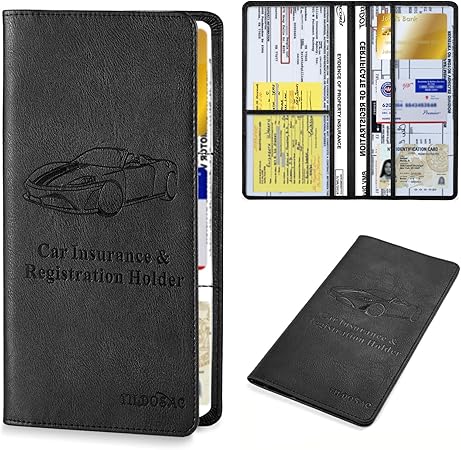
TILDOSAC Car Registration & Insurance Card Holder
- Well-Organized: Designed to keep important documents such as registration and insurance card, business cards, emergency information, paperwork, and gas card well-organized in one place.
- See-Through Design: The transparent material allows the owner to easily find the right document without having to fish through everything.
- Secure and Protective: The holder has 6 clear sleeves to securely store gas cards, car registration and insurance information, protecting them from damage or loss.
- Exquisite Craftsmanship: Made of high-quality materials such as sleek and trim PU leather and heavy-duty vinyl PVC, making it durable, anti-scratch, and tear-resistant.
- Slim Design with Enough Space: The slim, lightweight design is perfect for placement in any glovebox or console, and fits documents up to 9″x 4.7″(23cm x 12cm) while still having enough space to hold all you need. Suitable for cars, minivans, sedans, motorcycles, and boats.

Lusso Gear Car Organizer for Front Seat or Car Seat
- Organize: The Lusso Gear Car Front Seat Organizer helps declutter your front seat and organize your office and travel supplies in your vehicle.
- Fits Any Vehicle: It fits in any vehicle and is easy to install by attaching the strap to the passenger car seat headrest and adjusting to your preferred height.
- Multiple Compartments: The organizer is designed to provide multifunctional compartments and pockets for easy access, catering to different automotive users, including road warriors, soccer moms, and those who need a high-quality mobile office organizer.
- Stylish: The organizer is stylish and sturdy, and it comes with a built-in security flap that conceals the contents of your organizer and acts as a theft deterrent.

- Large Capacity and Foldable Design: L7.5″ x H11.5″x W7.5″ with a waterproof lining that is easy to clean and can be folded for storage when not in use.
- Superior Durability and Waterproof: Made of premium Oxford Polyester material, sturdy and firm, with a waterproof lining to prevent leaks and spills.
- Multi-functional Use: Features two side mesh pockets and a front pocket that can be used for storage of small items such as tissues, snacks, and drinks.
- Smart Multipurpose Design: The separated lid design allows for the use of disposable garbage bags while keeping the lid closed.
- Easy to Install: Adjustable straps with buckle for hanging in various locations such as the front or back of a seat, center console, glove box, or gear stick, and an elastic strap with hook to keep the bag in place and prevent spills.
What Factors Determine Whether You Need an SR-22?
1. Insurance Policy Lapse
An insurance policy lapse is when you fail to make your required payments, or your policy coverage is otherwise canceled. If your policy lapses, your insurance company is required to inform the Department of Motor Vehicles, which could result in the loss of your driver’s license. Additionally, if you no longer need an SR-22, your insurance provider must file an SR-26 form to remove the SR-22. Making payments on time will help keep your policy from being canceled and prevent your insurance provider from sending an SR-26 to the state.
2. Coverage Type and Amounts
An SR-22 is a certificate that verifies an individual has the minimum amount of car insurance required in their state. There are three types of SR-22 forms: an Owner form, an Owner-Operator form and a Non-Owner form. An Owner form provides coverage when an individual is driving a car they own. An Owner-Operator form provides coverage when driving both their own car and cars owned by others. A Non-Owner form provides coverage when an individual does not own their own car but drives cars owned by others. The amount of coverage and the specific requirements vary by state, but generally the coverage required consists of liability, property damage and uninsured/underinsured motorist coverage.
3. State Minimums
An SR-22 is a document issued by an insurance company that verifies you have the minimum liability insurance coverage required by your state. Each state has different requirements for SR-22s, and it’s important to know what your state’s minimums are. Generally, the minimums for an SR-22 include liability coverage of at least $25,000 per person and $50,000 per accident for bodily injury, and $20,000 per accident for property damage. In Virginia and Florida, a FR-44 is also required, which requires double the state’s minimum coverage. It’s important to check with your insurance provider to determine your state’s exact requirements and make sure you have adequate coverage.
4. Driver Information
To determine if an SR-22 is required for a driver, it is important to compare and contrast the Nebraska Financial Responsibility regulations with the individual’s driver and vehicle record. The relevant regulations can be found in the Nebraska Driver and Vehicle Records section, which outlines the requirements for filing an SR-22. Additionally, the driver’s manual or practice tests may also provide helpful information regarding this requirement. The information necessary to determine if an SR-22 is required includes the individual’s driving record, any outstanding financial responsibility requirements, and any other applicable state laws.
5. Driver License Suspension
When a driver’s license is suspended, the state Department of Motor Vehicles may require an SR-22 form, also known as a Certificate of Financial Responsibility, to be filled out and submitted. This document verifies that the driver has purchased the necessary vehicle insurance coverage required for the reinstatement of their driving privileges. If the SR-22 certificate lapses, the driver’s license could be suspended again. In order to obtain a restricted license, drivers must enroll in a DUI school, install an ignition interlock device, file an SR-22, and pay the restriction and reissue fees. Additionally, drivers convicted of a DUI may be required to attend and successfully complete a DUI school, and to file an SR-22 for a hardship license. Failure to fulfill these requirements can result in further driving privileges being revoked.
6. Number of Accidents
The number of accidents has a significant effect on the need for an SR-22. If someone has multiple smaller traffic infractions, like speeding or running red lights, failed to pay damages after being at fault in an accident, or been at fault in an accident while driving without insurance, they may be required to obtain an SR-22. Furthermore, if someone has committed a serious traffic infraction, such as a DUI, driving without insurance three or more times, or failed to continuously maintain a previous SR-22 for three years, they may be required to obtain an SR-22. It is important for drivers to be aware of the consequences of their actions and take the necessary steps to prevent further incidents. To promote safe driving habits, it is also important for parents to go over essential driving skills with teenagers before they get behind the wheel and for drivers of all ages to be aware of intersection safety and red light cameras, avoid texting and driving, and be conscious of car insurance deductibles.
7. Penalty Amounts
The penalty amounts for not having an SR-22 can vary depending on the state and the severity of the infraction. Generally, the penalties include fines, license suspension, jail time, and other punitive measures. Fines for not having an SR-22 can range from $100 to over $1,000, license suspension can be temporary or permanent, and jail time can range from a few days to a year or more. Other punishments may include the revocation of your driving license, the suspension of your vehicle registration, the installation of an ignition interlock device, alcohol treatment programs, and the requirement to obtain an SR-22.
8. Insurance Company
Insurance companies determine if an SR-22 is required by assessing an individual’s driving record, risk factors and financial status. They will look at the number of tickets, DUIs, suspensions and other violations to determine if the driver poses a higher risk to the insurance company. They also evaluate the driver’s credit score, income and other financial factors to determine the driver’s ability to pay for the insurance premiums. After collecting this information, the insurance company can decide whether or not to require an SR-22 filing. If an SR-22 is deemed necessary, the company will provide the driver with the necessary forms to file with their state’s Department of Motor Vehicles. Once the SR-22 form is filed, the driver can then purchase the necessary insurance coverage from an insurance company that specializes in SR-22 coverage or from one of the many large auto insurers that offer it.
9. Car Insurance Policy Requirements
What are the car insurance policy requirements for an SR-22? [Step-by-step instructions]:
1. Check your state’s insurance requirements to determine if you need an SR-22 to prove you have insurance.
2. Contact your insurance provider to find out the specific SR-22 coverage requirements in your state.
3. Buy an SR-22 auto insurance policy that meets your state’s requirements.
4. Retain both the SR-22 and your insurance policy for the required amount of time, typically three years.
5. If your insurance policy lapses, your insurer must notify the Department of Motor Vehicles office.
6. Once you have met your SR-22 obligations, your SR-22 status will be removed.
7. In some cases, you may be required to buy a non-owner SR-22 in order to reinstate your driving privileges.
How to Get an SR-22 and What Are the Costs?
Step 1: Find out if you need an SR-22
If you’ve been caught driving without insurance or a valid license, or you’ve been convicted of a DUI or DWI, you may need an SR-22. To find out if you need an SR-22, contact your insurance company, the DMV or the court.
The process for getting an SR-22 varies by state, but typically you need to indicate you need to file an SR-22 when you purchase your auto insurance policy and provide your driver’s license number or other identification number. Your insurance provider will add the SR-22 endorsement to your existing policy and then file the document with the state that requires it.
If your insurance company doesn’t offer SR-22s, you’ll need to buy a new policy. Make sure you let potential insurers know upfront that you need an SR-22 coverage to save yourself some time.
If you don’t own a car, you may still be required to have an SR-22 certificate and an SR-22 auto insurance policy. You may be able to buy a non-owner SR-22 policy in order to satisfy the requirement.
Step 2: Get a form from the state department
Getting an SR-22 form from the state department is a process that can vary by state. Generally, you will need to contact your auto insurance company to start the process. Depending on the insurer, you may need to purchase a policy in order to get your driving privileges reinstated. The insurer will then file the SR-22 form with your state’s transportation agency. The cost for an SR-22 form may vary depending on your state, but typically, your insurance company will cover the filing fee. You may also be required to pay the entire premium upfront, for either six or twelve months. To check if the SR-22 has been filed, you can contact your insurance company or the DMV.
Step 3: Fill out the form
If you need to file an SR-22, the process begins with submitting an application for car insurance. Before doing so, it is important to avoid common mistakes when filling out the application. After completing the application, you may need to schedule an appointment and submit driver safety waivers and certificates of completion. Additionally, if you are a non-commercial driver, you may need to satisfy new citizenship requirements.
Once you have purchased the insurance, the insurer will e-file your SR-22 for you. You can estimate the vehicle tax online and change your address online as well. Furthermore, if you already have a policy, you can log in via your browser and navigate to update the driver who needs an SR-22.
The cost of filing an SR-22 will depend on your insurance provider, as each company may have different rates and fees. It is best to contact your insurance provider for the exact cost.
Step 4: Give it to the police
Giving an SR-22 to the police can be done in a few easy steps. First, contact your insurance company to make sure the SR-22 has been filed. You can also check with the DMV or court to make sure the SR-22 has been received and processed. Once you have verified the SR-22 has been filed, pay any court fees associated with it. Ignoring these fees will only delay the process and make your situation worse. If you cannot pay all of the fees upfront, you can set up a payment plan. Once the fees are paid, the SR-22 will be sent to the police. You may need to present proof of the SR-22 to the police, so make sure you keep a copy on hand.
Step 5: Wait for a determination from the cour
How long does it take to get a determination from the court on an SR-22 application? On average, it takes about 30 days to receive a determination from the court on an SR-22 application. It is best to contact your insurance company, DMV, or court to find out if the SR-22 has been received and processed.
Step 6: Pay for the SR-22
Getting an SR-22 form can be expensive, depending on the state you live in. The filing fee is typically around $25, but you may be required to pay the entire premium upfront, either for six or 12 months. Additionally, your car insurance rates may increase when you need an SR-22, and the cost of insurance for an SR-22 in Florida must be kept up-to-date for three years. All in all, the cost to pay for an SR-22 can be quite substantial.
Step 7: Keep track of the time requirements for filing an SR-22
Filing an SR-22 is a time-consuming process, and typically takes 30 days to complete. The length of time you need to maintain an SR-22 certificate depends on the state you live in. Generally, you will need to have an SR-22 showing continuous insurance coverage for three years, although this may vary in some states.
When the clock starts for this time period also varies by state—it may start with the offense date, conviction date, suspension date, or the date when the state reinstated your license. To ensure that you comply with the terms of your SR-22, you should pay your premiums on time and renew your policy when necessary. If you cancel your policy before the time period is up, your SR-22 filing will no longer be valid.
To find out if your SR-22 has been filed, contact your insurance company. You can also check with the DMV or the court to find out if the SR-22 has been received and processed. If you need to file an SR-22, it’s important to know when the clock starts ticking and when the violation falls off your driving record. Be sure to check with your insurance provider and your state’s transportation agency to find out their specific requirements.
Step 8: Research companies that file SR-22s
Researching companies that file SR-22s is an important step in obtaining the necessary coverage needed to get your license reinstated. There are several steps you can take to ensure you are getting the best coverage and the best rate.
First, you must decide if you want to use the auto insurance provider you already have or search for an alternate option. If you choose to go with the same insurer, call them and request an SR-22 form filing. They’ll add the SR-22 endorsement to your existing policy and then file the SR-22 insurance document with the state that requires it. If your current insurance provider does not offer SR-22s, you will need to search for a new policy.
Next, you can shop around to find the best rate. Different insurers may offer significantly different premium rates and some may be more flexible based on your charges and what steps you’re taking to get back on track. There are many insurers that specialize in coverage for high-risk drivers and offer SR-22 filing, such as 21st Century, Dairyland, Direct Auto, Gainsco, The General, Infinity, Kemper, National General, and Safe Auto. Many of the largest auto insurers also offer SR-22 insurance forms, including Allstate, American Family, Geico, Progressive, State Farm, and USAA.
Once you’ve found an insurer that meets your needs, contact them for more information. You may need to provide proof of financial responsibility and fill out a form to obtain an SR-22. Once the form is completed, the insurer will submit it to the state Department of Motor Vehicles (DMV). Once the DMV receives and processes the form, your license will be reinstated.
To verify that the SR-22 form has been filed correctly, contact your insurance company. You can also check with the DMV or the court to find out if the SR-22 has been received and processed.
By researching companies that offer SR-22 filing, you can ensure you are getting the coverage and rate you need to get your license reinstated.
Step 9: Choose the right type of non-owner car insurance coverage with an SR-22
For individuals who do not own a vehicle but are required to carry an SR-22, non-owner car insurance is an option to fulfill their filing requirements. There are three different types of SR-22 forms available, and the cost may vary depending on the type of policy and insurance company.
Owner SR-22 coverage is the most expensive, as it provides liability coverage for when you drive your own car.
Owner-Operator SR-22 coverage is less expensive than owner coverage and provides liability coverage when you drive your own car and cars owned by others.
Lastly, Non-Owner SR-22 coverage is the most affordable and provides liability coverage when you drive someone else’s car occasionally.
The cost of non-owner SR-22 coverage will vary depending on the insurance company and the state you live in. Insurance.com commissioned rate data from Quadrant Data Services based on a 40-year-old male driver with a 2021 Honda Accord LX and rate data was collected in 2022 from multiple companies and ZIP codes in every state.
For further information on non-owner car insurance and SR-22 filing requirements, contact your insurer or a specialized insurance agent in your area.
Step 10: Contact them to get a filing done
Bonus Step 11 : Use online calculators to estimate the cost of different types of DUI insurance policies
If you have been convicted of a DUI or related offense, you may need to purchase a special type of car insurance policy to get your driving privileges restored. Knowing the cost of different types of policies is an important part of making sure you are getting the best deal on your insurance. Luckily, there are online calculators that can help you estimate the cost of different types of DUI insurance policies. Here’s a step-by-step guide for estimating the cost of DUI insurance:
Step 1: Visit the website of a car insurance company that offers DUI insurance policies.
Step 2: Look for an online calculator tool that can help you determine the cost of different types of car insurance policies.
Step 3: Enter your personal information, including your age, where you live, your driving history, and any other information the calculator requires.
Step 4: Compare the estimated cost of different types of DUI insurance policies, such as high-risk auto insurance, non-owner car insurance, and SR-22 insurance.
Step 5: Contact an insurance agent directly to get a customized quote for a policy that meets your needs.
For example, if you are a 40-year-old driver living in Florida with a recent DUI, you can use an online calculator to estimate the cost of a DUI insurance policy with an SR-22. You may find that Progressive offers the cheapest rates on average for 40-year-old drivers with a DUI, but Geico may offer better rates in Florida, Maryland and Utah. You can then contact an agent directly to get a customized quote for a policy that meets your needs.